
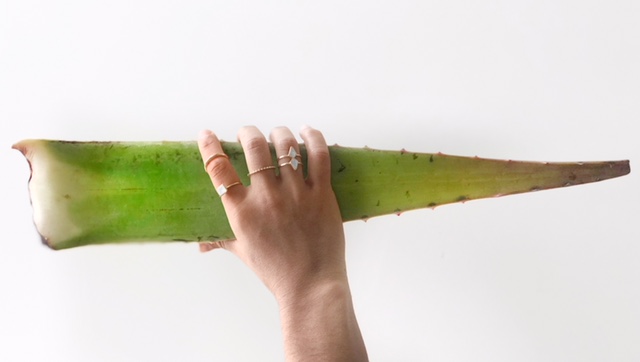
In a world where every day we are introduced to new products, new brands and new promises, we end up leaving aside some simple and natural options that bring numerous benefits to our health, which are free of various chemical substances that can be toxic to our body and all this at a much more interesting cost. Knowing this, I always try to look for natural alternatives for my routine!
how to use
A lot of people ask me about aloe vera, I don’t use it every day, but I really like to include it in my self care ritual, applying the gel to my skin after a sunny day or as a face mask and sometimes I apply it to the hair root too! In addition, I have used it to improve my digestion, when I feel that my stomach needs an extra love, I include it in my smoothies or morning shots. But it takes a little care and attention before including the plant with internal use in its routine, Aloe Vera has a slightly laxative power and therefore is not suitable for people who have a digestive problem (hemorrhoids, many going to the bathroom, diarrhea, disease) by Crohn..etc). The plant is just another alternative to improve a picture and it is very important to check with your nutritionist and/or doctor if your consumption is right for you too.
In this post I will share some benefits of this amazing plant, as I include it in my self-care ritual, in my diet and also answer some practical questions on how to use, store and where to find it!
Aloe Vera benefits

Aloe Vera has more than 75 active components in its composition, which can benefit our body and organism in different ways. Among the components present in the plant, the amount of minerals draws a lot of attention, laboratory analyzes identified the presence of: calcium, copper, selenium, manganese, magnesium, potassium, sodium and zinc. These minerals play a key role in ensuring the proper functioning of enzyme systems of different metabolic pathways and some also play an antioxidant role in our body.
In addition, the plant is an excellent source of essential vitamins, such as: vitamin A (beta-carotene), C and E, in addition to B12, folic acid and choline. These substances have great antioxidant power when fighting free radicals. The presence of some enzymes in the plant makes it an excellent ally to fight inflammation. Bradykinin, for example, helps to reduce excessive inflammation when applied to the skin topically, while other enzymes help break down sugars and fats. A curious fact is that the plant has in its composition 7 of the 8 essential amino acids and 20 of the 22 non-essentials (that is, our own organism is able to synthesize/produce) and also contains salicylic acid, which has anti-inflammatory properties. and antibacterial.
Several studies point to the benefits of aloe vera for health and skin improvement, among them we have: Protective effect against damage caused by solar radiation, improvement of healing Once its active compounds stimulate collagen synthesis, improvement in the Psoriasis, dermatitis, oral mucositis, surgical wounds and also as a home remedy for burns. Thinking about hair health, the plant is a great option to treat and moisturize hair and scalp. The numerous minerals and vitamins present in the plant contribute to strong and healthy hair and its antibacterial and antifungal properties contribute to the reduction of dandruff. In addition, its enzymes help to eliminate dead cells from the scalp and promote the regeneration of the skin tissue around the hair follicles.
Thinking now about our digestive system, Aloe Vera presents anthraquinones, compounds known for their laxative power, which work as a natural laxative: they increase the intestinal fluid, stimulate the secretion of mucus and drive the movement. Peristaltic of the intestine, thus being a natural option to help those who suffer from constipation. In addition, due to its anti-inflammatory components combined with laxative substances present in its composition, the plant proved to be a good ally to optimize the digestive process. A study It related the consumption of aloe vera with improvements in the patients with irritable bowel syndrome (IBS), but we still do not have enough data to prove the effectiveness of this type of treatment.
In practice
How to use on the skin: The aloe vera gel is nothing more than the inner part of the leaf, which naturally has a sticky gel texture. To use it, I suggest you cut a small piece of the leaf and with the help of a spoon, remove the transparent part and apply it directly to the face or in the place you would like to treat and let it dry, the ideal is to leave the plant in contact with the skin for at least 20 minutes and then wash with warm water or remove the excess with the help of a towel.
How to use it on hair: Remove the inner part of the plant and to facilitate the application, liquefy for a few seconds until it reaches a gel texture. You can add a few drops of tea tree essential oil or Castor Oil (both has beneficial properties for hair health) or combine it with any other product of your choice – they are just suggestions, the plant itself already offers many benefits. Apply the mixture from the root to the ends and let it act for a few minutes (I suggest at least 30 minutes for your body to have time to absorb the substances) and wash normally afterwards.
How to include in smoothies and shots: With the help of a spoon or with a knife, only separate the transparent part of the plant (the gel), include it in your smoothie and blend normally. In the case of shots, due to the gel texture, it may be necessary to blend the plant with a little water before and then combine the other ingredients. Consume right away! The amount indicated can vary from person to person, so it is important to talk to your nutritionist about it.
Where to find: US: Whole Foods, Trader Joes and Farmers Market. Brazil: natural products stores and organic fairs and markets
How to store: I keep the whole sheet in the fridge and cut the pieces when I go to use it.
* Aloe vera consumption is not recommended for pregnant women or lactating women since its active components can cause gastrointestinal discomfort.
**Remembering that this post does not replace a medical consultation and that the benefits presented from the plant do not replace prescribed medication(s) by a doctor(s).
REFERENCES:
Surjushe A, Vasani R, Saple DG. aloe vera: A short review. indian j dermatol. 1999;53:163–166